
Corporate actions can significantly influence investor decisions, stock liquidity, and future market activity. Among the most closely monitored corporate actions are stock splits and warrant issuances, both of which can impact shareholder behavior and trading dynamics.
In many investment research workflows, analysts need a centralized view of upcoming corporate actions rather than reviewing multiple data sources separately. By combining Stock Split Calendar and Warrant Calendar data into a single dataset, investors can monitor important market events more efficiently.
This notebook demonstrates how to build a Corporate Action Calendar Intelligence workflow using Python.
The project combines two APIs from the Indonesia Stock Exchange ecosystem:
Stock Split Calendar API
Warrant Calendar API
Instead of analyzing both datasets separately, the notebook retrieves, normalizes, merges, and summarizes the information into a unified corporate action calendar that can support investment research and market monitoring.
CELL 1 — Import Libraries
import requests
import pandas as pd

print("Libraries imported successfully.")
Explanation
Cell 1 prepares the notebook environment by importing the required Python libraries.
The notebook imports:
requestsfor API communication.pandasfor dataframe creation and data processing.
These libraries provide the foundation for retrieving and analyzing corporate action data from the Indonesia Stock Exchange APIs.
At the end of the cell, a confirmation message is displayed indicating that all required libraries have been imported successfully.
CELL 2 — Configure APIs and Retrieve Data
RAPIDAPI_KEY = "YOUR_API_KEY"

headers = {
    "Content-Type": "application/json",
    "x-rapidapi-host": "indonesia-stock-exchange-idx.p.rapidapi.com",
    "x-rapidapi-key": RAPIDAPI_KEY
}

# Stock Split Calendar
stocksplit_url = (
    "https://indonesia-stock-exchange-idx.p.rapidapi.com/"
    "api/calendar/stock-split"
)

# Warrant Calendar
warrant_url = (
    "https://indonesia-stock-exchange-idx.p.rapidapi.com/"
    "api/calendar/warrant"
)

stocksplit_data = requests.get(
    stocksplit_url,
    headers=headers
).json()

warrant_data = requests.get(
    warrant_url,
    headers=headers
).json()

print("API data fetched successfully.")
Explanation
Cell 2 handles API configuration and data collection.
The notebook first creates authentication headers required to access the Indonesia Stock Exchange API.
Two API endpoints are then defined:
Stock Split Calendar endpoint
Warrant Calendar endpoint
Using requests.get(), the notebook retrieves both datasets and converts the responses into JSON format using .json().
This step serves as the primary data collection stage of the corporate action monitoring workflow.
After both API requests are completed, the notebook confirms that the data has been fetched successfully.
CELL 3 — Normalize Corporate Action Data
# Stock Split
if "data" in stocksplit_data:
    df_stocksplit = pd.json_normalize(
        stocksplit_data["data"]
    )
else:
    df_stocksplit = pd.json_normalize(
        stocksplit_data
    )

# Warrant
if "data" in warrant_data:
    df_warrant = pd.json_normalize(
        warrant_data["data"]
    )
else:
    df_warrant = pd.json_normalize(
        warrant_data
    )

# Add event type
df_stocksplit["event_type"] = "Stock Split"
df_warrant["event_type"] = "Warrant"

print("Stock Split Shape:",
      df_stocksplit.shape)

print("Warrant Shape:",
      df_warrant.shape)
Explanation
Cell 3 transforms raw API responses into structured dataframes.
The notebook first checks whether each API response contains a data field.
If the field exists, pd.json_normalize() extracts and flattens the nested JSON structure. Otherwise, the entire response is normalized.
Two dataframes are created:
df_stocksplitdf_warrant
The notebook then adds a new column called event_type to identify the origin of each record.
This classification allows both datasets to be combined later while preserving event categorization.
Finally, the notebook displays the shape of both datasets to provide a quick validation of the retrieved records.
CELL 4 — Combine Corporate Action Calendars
corporate_calendar = pd.concat(
    [
        df_stocksplit,
        df_warrant
    ],
    ignore_index=True
)

print("Total Corporate Actions:",
      len(corporate_calendar))

display(
    corporate_calendar.head()
)
Explanation
Cell 4 combines both corporate action datasets into a single calendar.
Using pd.concat(), the notebook merges:
Stock Split events
Warrant events
The resulting dataframe is stored in corporate_calendar.
Combining multiple corporate action sources into a single dataset provides a centralized view of upcoming market events.
The notebook then displays:
Total number of corporate actions
A preview of the merged dataset
This consolidated structure simplifies future analysis and reporting.
CELL 5 — Corporate Action Intelligence Report
print("=" * 60)
print("CORPORATE ACTION CALENDAR INTELLIGENCE")
print("=" * 60)

print("\nTotal Events:")
print(len(corporate_calendar))

print("\nStock Split Events:")
print(len(df_stocksplit))

print("\nWarrant Events:")
print(len(df_warrant))

print("\nEvent Distribution:")
print(
    corporate_calendar[
        "event_type"
    ].value_counts()
)

print("\nUpcoming Corporate Actions:")
display(
    corporate_calendar[
        ["event_type"]
    ].head(10)
)

print("\nInvestor Insight:")
print("""
• Stock Split events may improve stock affordability
  and increase liquidity.

• Warrant events may create additional opportunities
  for shareholders to acquire shares.

• Monitoring both events helps investors prepare
  for potential market reactions.
""")

print("=" * 60)
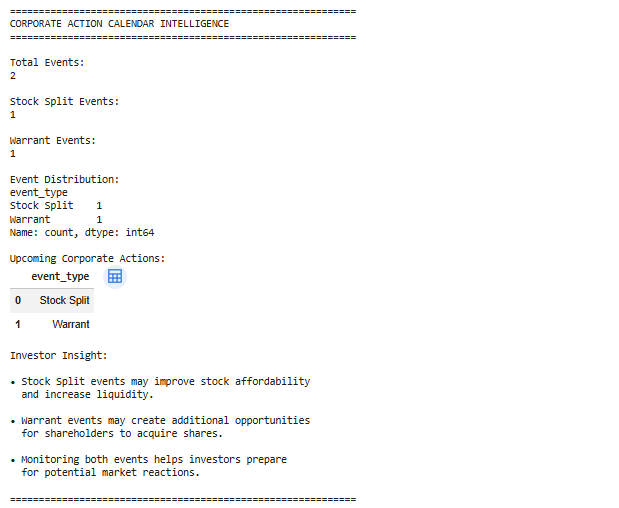
Explanation
Cell 5 generates the final Corporate Action Calendar Intelligence report.
The notebook summarizes several important metrics:
Total corporate action events
Total stock split events
Total warrant events
Event distribution by category
It also displays a preview of upcoming corporate actions, allowing investors to quickly review future events.
The final section provides investor-oriented insights explaining the potential significance of:
Stock split announcements
Warrant issuances
Corporate action monitoring
This report transforms raw API data into practical market intelligence that investors can use for planning and research.
Result:
OVERALL WORKFLOW
This notebook follows a simple and structured corporate action intelligence workflow.
First, it imports the required Python libraries.
Second, it configures API authentication and retrieves data from both the Stock Split Calendar API and Warrant Calendar API.
Third, it normalizes the API responses into structured pandas dataframes.
Fourth, it categorizes each dataset using an event type label.
Fifth, it combines both datasets into a unified corporate action calendar.
Finally, it generates a summary report and investor insights that help interpret upcoming corporate actions.
The final output is a centralized corporate action monitoring dataset that simplifies investment research and market event tracking.
WHY THIS CASE MATTERS
Many investors focus only on price charts and financial statements.
However, corporate actions often influence market sentiment, liquidity, and shareholder decisions.
Stock splits can improve stock affordability and increase trading participation, while warrant issuances may create future investment opportunities and affect capital structure.
By combining Stock Split Calendar API and Warrant Calendar API data into a single workflow, investors gain a clearer view of upcoming market events.
This approach creates a stronger foundation for market awareness and corporate action monitoring.
CONCLUSION
This tutorial demonstrates how to build a Corporate Action Calendar Intelligence workflow using Python, Stock Split Calendar API, and Warrant Calendar API.
The notebook retrieves corporate action data, converts API responses into structured dataframes, categorizes events, combines multiple datasets, and generates an investor-focused intelligence report.
The final workflow provides:
Corporate action monitoring
Stock split tracking
Warrant event tracking
Event distribution analysis
Investor intelligence reporting
For investors, analysts, and fintech developers, this project provides a practical foundation for building automated corporate action monitoring systems and investment research tools.
Ultimately, the project is not simply about calling two APIs. It is about transforming corporate action data into meaningful market intelligence that helps investors stay informed about important upcoming events.